
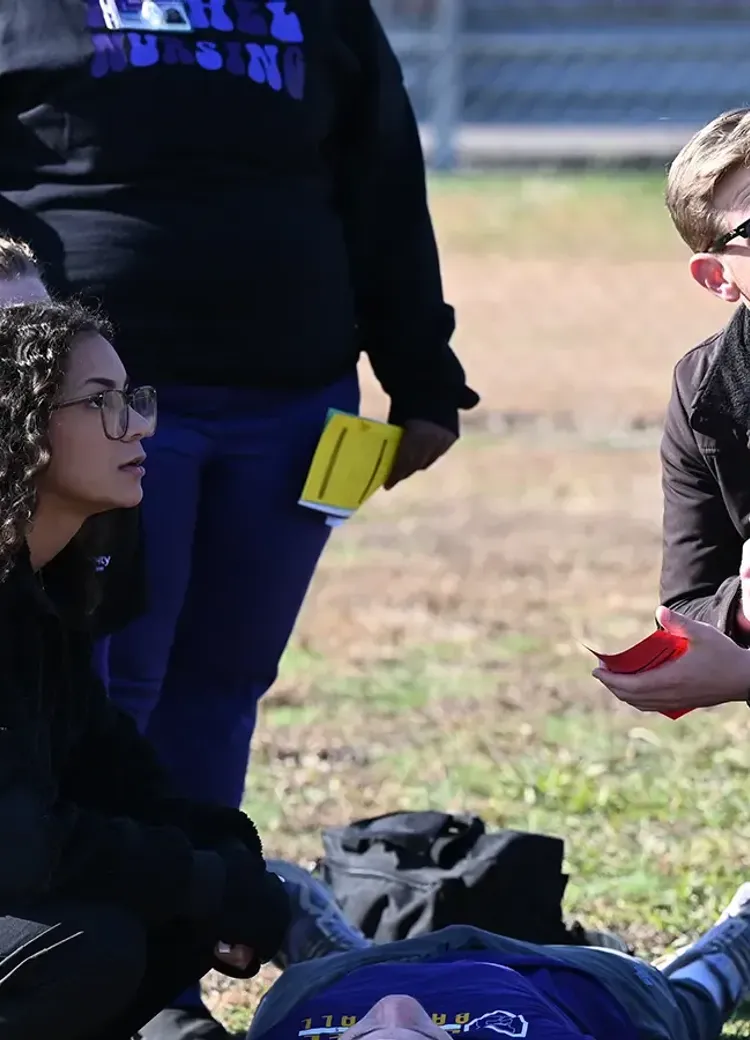
Organized by the Physician Assistant Program, the interprofessional exercise brought physician assistant and nursing students together with area emergency responders
by Bethel University
McKENZIE, Tenn. — Physician assistant and nursing students in Bethel University’s College of Health Sciences put their classroom training to the test Nov. 12 during Operation Weakley County, a disaster response exercise held with emergency agencies from across Weakley County at Gleason Raceway Park in Gleason.
The exercise was planned and led by Leanna Brown, DNP, MBA, MSS, ACNP-BC, clinical director and associate professor in the Bethel University Physician Assistant Program. Brown worked with each partner agency to build a scenario around a tornado striking a fictional high school, with students responding to simulated patients as they would in a real mass-casualty event. It was the first exercise of its scope for Bethel.
Operation Weakley County was designed as an interprofessional education exercise, in which students from different health professions learn with, from and about one another. In practice, physician assistants, nurses, paramedics and other providers care for patients as a team, but much of their training happens within their own programs. Exercises like this one let students see what each profession brings to a patient’s care and practice the communication, handoffs and shared decision-making a real emergency demands, long before they face one on the job.
“Exercises like Operation Weakley County show what sets our College of Health Sciences apart,” said Delecia Parker, DNP, MSN, RN, dean of the College of Health Sciences. “Our physician assistant and nursing students learned to rely on one another under pressure, side by side with the professionals who serve this community every day. That is the kind of preparation our region needs from the clinicians we send into it.”
The exercise followed the order of a real disaster response. Nursing students reached the simulated patients first, performing triage to sort them by the urgency of their injuries. Physician assistant students then served as the medical providers, reviewing each triage decision, treating injuries and deciding how and where each patient would be transported. Throughout the morning, students handed patients off to paramedics and worked under the direction of the incident commanders running the scene.
“Triage is where every disaster response begins, and our nursing students were the first to reach each patient,” said Ashley Johnson, PhD, MSN, RN, CNEcl, director of nursing. “They made quick decisions, communicated them clearly and handed patients to the PA team with confidence. That kind of experience is hard to recreate in a classroom or skills lab.”
“Disaster response is not the responsibility of one profession, one agency or one organization,” Brown said. “It requires all of us working together.”
One of the most valuable lessons for students, Brown said, was that emergency response begins long before a health care provider reaches a patient. Scene safety, hazard identification, traffic management, incident command, triage and transportation are all essential, and every profession on scene brought something important.
The exercise also drew on talent from across the University. Social Sciences faculty and students filled a variety of roles, and a Chaplain Services representative demonstrated the importance of emotional and spiritual support during a crisis.
Operation Weakley County also reflects the College of Health Sciences’ commitment to experiential learning, a cornerstone of Bethel’s mission. Simulation lets students make high-stakes decisions without putting real patients at risk, and an exercise this large adds the uncertainty and time pressure of an actual emergency. Each simulated patient was given a detailed case with injuries that could change during the exercise, challenging students to reassess and adapt in real time.
Bringing an operation of this scale together took many hands. Bethel faculty and staff spent weeks meeting with partner agencies, mapping the raceway property for treatment areas and aircraft landing zones, and building a minute-by-minute schedule for every participant. That level of detail allowed students to experience the pressure of a real disaster in a setting where they could learn from every decision.
Brown said she hopes students carry the experience throughout their careers. “Knowing how to recognize a life-threatening condition matters,” she said. “So does knowing when to listen, when to lead, when to follow, and how to work respectfully alongside others.”
The exercise also served as valuable training for the agencies that took part. Operation Weakley County gave law enforcement, fire, emergency medical, emergency management and aviation crews from across the county a chance to practice a coordinated mass-casualty response together, from scene safety and traffic control to incident command, patient transport and aircraft landing zones. Working through a realistic scenario ahead of a real emergency helps responders from different agencies build the communication and trust a disaster demands.
“When a real emergency occurs, it will not matter which uniform we wear or which agency we represent,” Brown said. “What will matter is that we are prepared, that we trust one another, and that we work together to save lives.”
Bethel University is deeply grateful to the law enforcement officers, first responders and community partners who made the exercise possible, including the Weakley County Sheriff’s Office, Dresden Fire Department, Weakley County Emergency Management Agency, Carroll County Emergency Management, Tennessee Highway Patrol, AMR Ambulance Service, Air Evac Lifeteam 31, TEMA, Tennessee Department of Homeland Security and the Tennessee Army National Guard. Special thanks go to Gleason Raceway Park for the use of its property, to the volunteers who portrayed patients, to the faculty and staff who served throughout the morning, and to Weakley County residents for their patience and support.
The Physician Assistant Program plans to hold Operation Weakley County annually.
About Bethel University
Founded in 1842, Bethel University has spent nearly 185 years helping students turn their talents into purpose. Located in McKenzie, Tennessee, within two hours of both Nashville and Memphis, Bethel is a Christian community of nearly 3,000 students from 33 states and 41 countries. The University’s mission is to equip individuals for a life of service through academic, spiritual, social and experiential learning to go forth and transform the world. With 52 undergraduate programs and nine graduate programs, Bethel aims to be a leader in student-centered education through innovative academics, character formation and life skills development. For more information, visit bethelu.edu.
About the College of Health Sciences
Bethel University’s College of Health Sciences shapes clinicians who lead with skill and a servant heart, preparing students for careers in health care through its Physician Assistant and Nursing programs. The Physician Assistant Program’s 27-month master’s degree in physician assistant studies pairs 12 months of intensive classroom instruction with 15 months of clinical experience in a small, close-knit learning community built on individualized mentorship. The Nursing Program offers two pathways to a bachelor’s degree in nursing. Direct Entry admits qualified first-year and transfer students straight into the nursing major, so their path to becoming a nurse begins their first semester. The four-year LPN to BSN program lets licensed practical nurses keep working while they earn their degree, with most coursework online and clinicals close to home.